This is the first post in a series of articles addressing AI’s impact on capital markets. In this installment we focus on AI’s potential impact on one of the fastest-growing segments of the investment management industry: quantitative hedge funds.
Over the last several decades, some of the world’s most powerful investment firms were built around a relatively radical idea: markets could be understood through data and mathematics better than through human analysis alone.
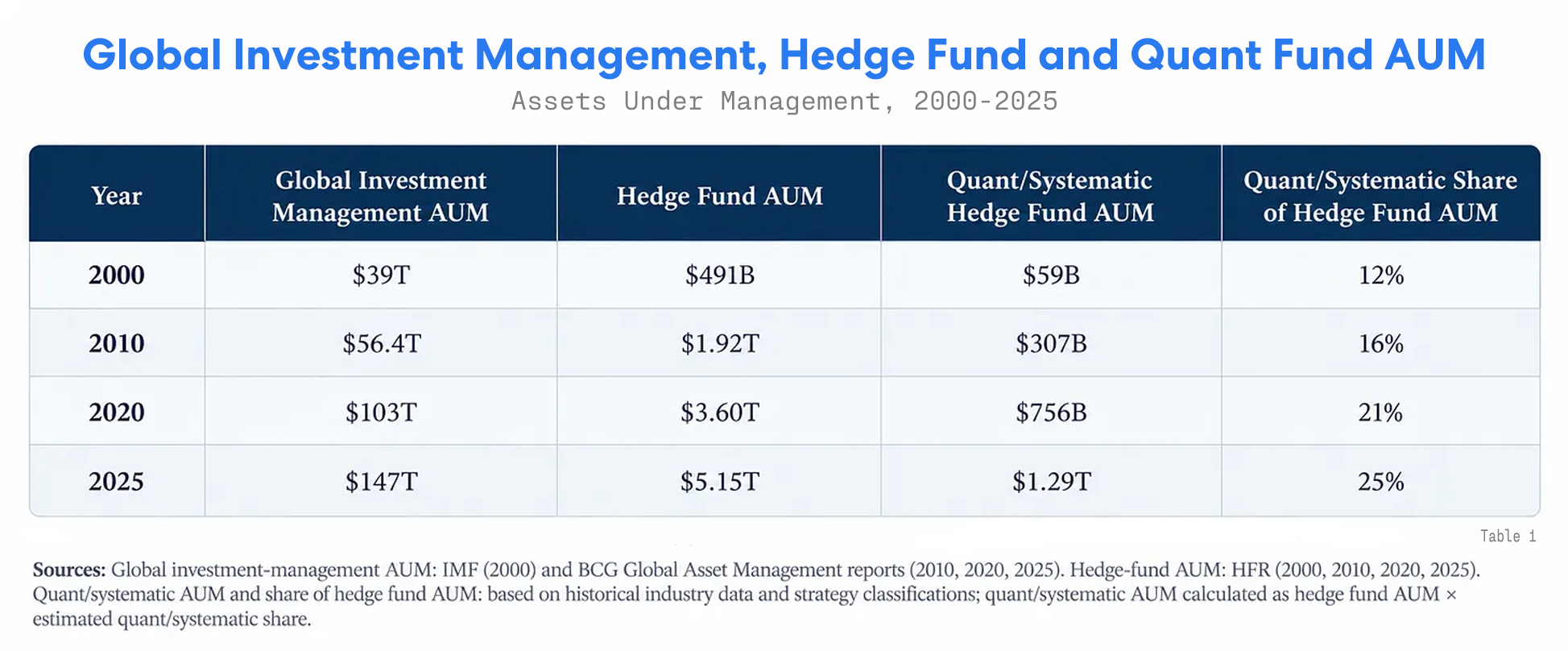
We can see this most clearly within the hedge fund industry. Since the year 2000, the global investment management AUM grew by a CAGR of about 5.5%, while hedge funds grew their AUM by a CAGR of 10% over that same time period. The fastest-growing part of that industry was quantitative or systematic strategies, which doubled their share of hedge fund AUM, from 12% ($59 billion) in 2000 to 25% ($1.3 trillion) as of 2025 (see Table 1).
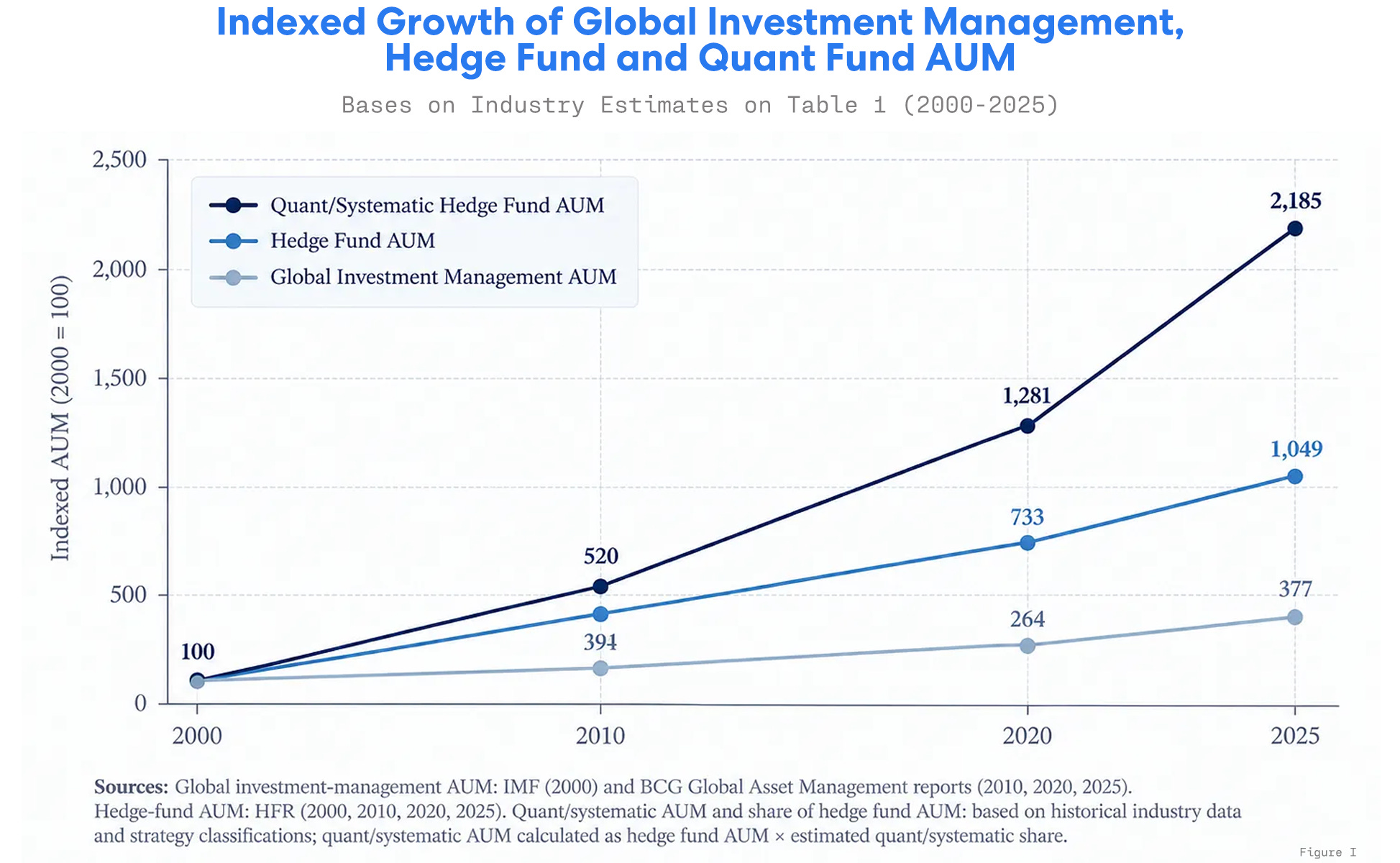
To make the comparison in growth clearer, Figure 1 below sets each category equal to 100 in the year 2000 and then shows how much each one grew from that starting point. By 2025, global investment management AUM rose to 377, meaning it grew roughly 3.8x. Hedge fund AUM reached about 1,049, or roughly 10.5x its 2000 level. Finally, quantitative or systematic hedge fund AUM reached 2,185, jumping 22x from its starting point. All three categories posted solid growth, but the quant-oriented hedge funds outgrew the industry by a wide margin.
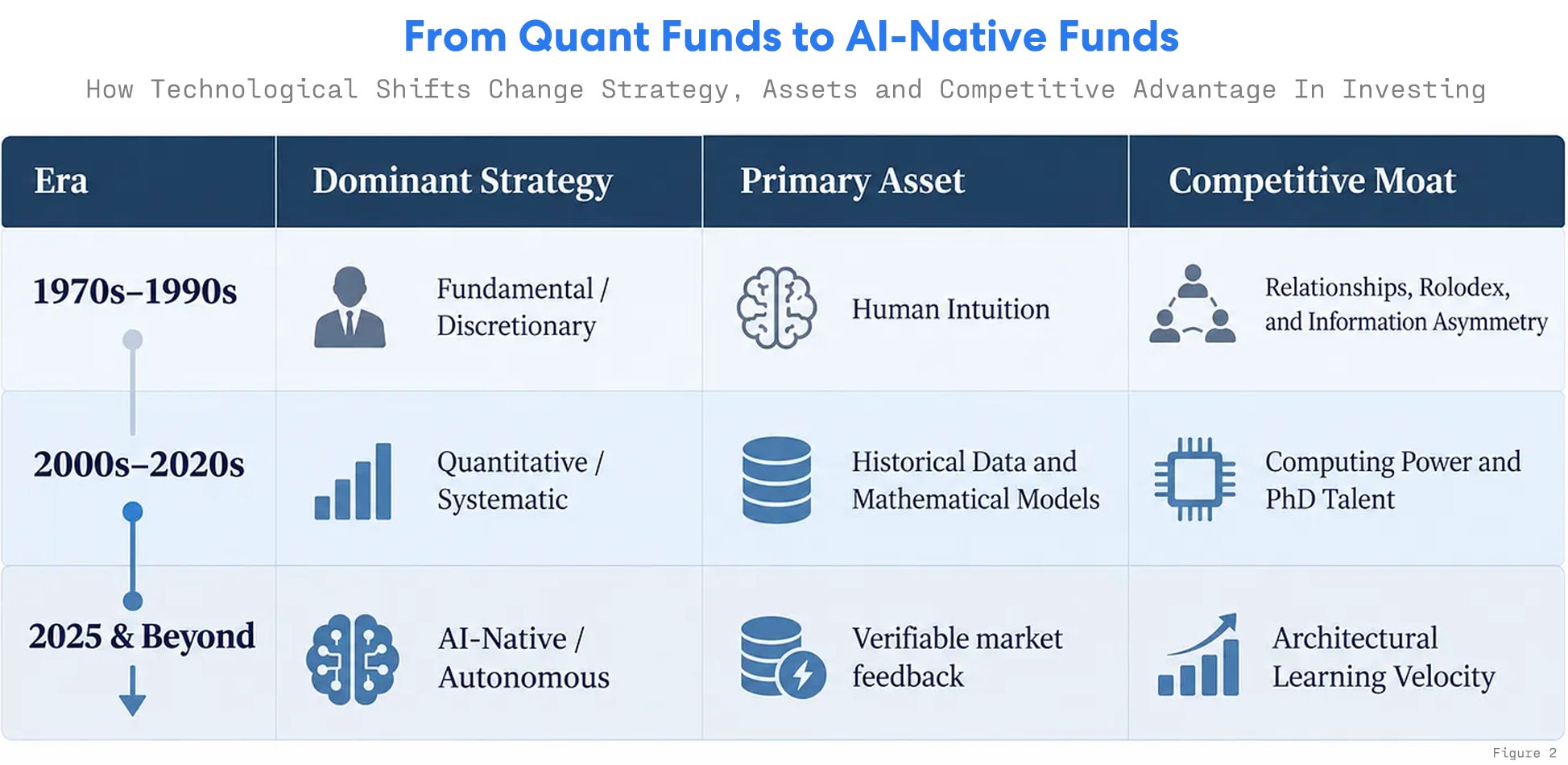
That outsized growth in quantitative and systematic strategies did not require AI as we know it today. It was driven by a different set of technological breakthroughs, including cheaper computing, electronic trading, cloud infrastructure, and greater accessibility to larger datasets. The formula for building a leading quantitative investment firm required assembling exceptional mathematical talent, acquiring enormous amounts of data, deploying massive computing resources, and building better investment models than competitors. That formula created some of the most successful investment firms of the last generation.
From Quant Funds to AI-Native Funds
We believe another transition is beginning, once again triggered by a technological breakthrough. AI systems can increasingly reason, act, experiment, and learn from outcomes at a scale that was previously impossible. But the next generation of great investment firms will not simply use AI to make their analysts more productive. They will integrate AI as a core part of the investment architecture and, as a result, of every step of the investment process. The biggest change will once again be organizational in nature (see Figure 2).
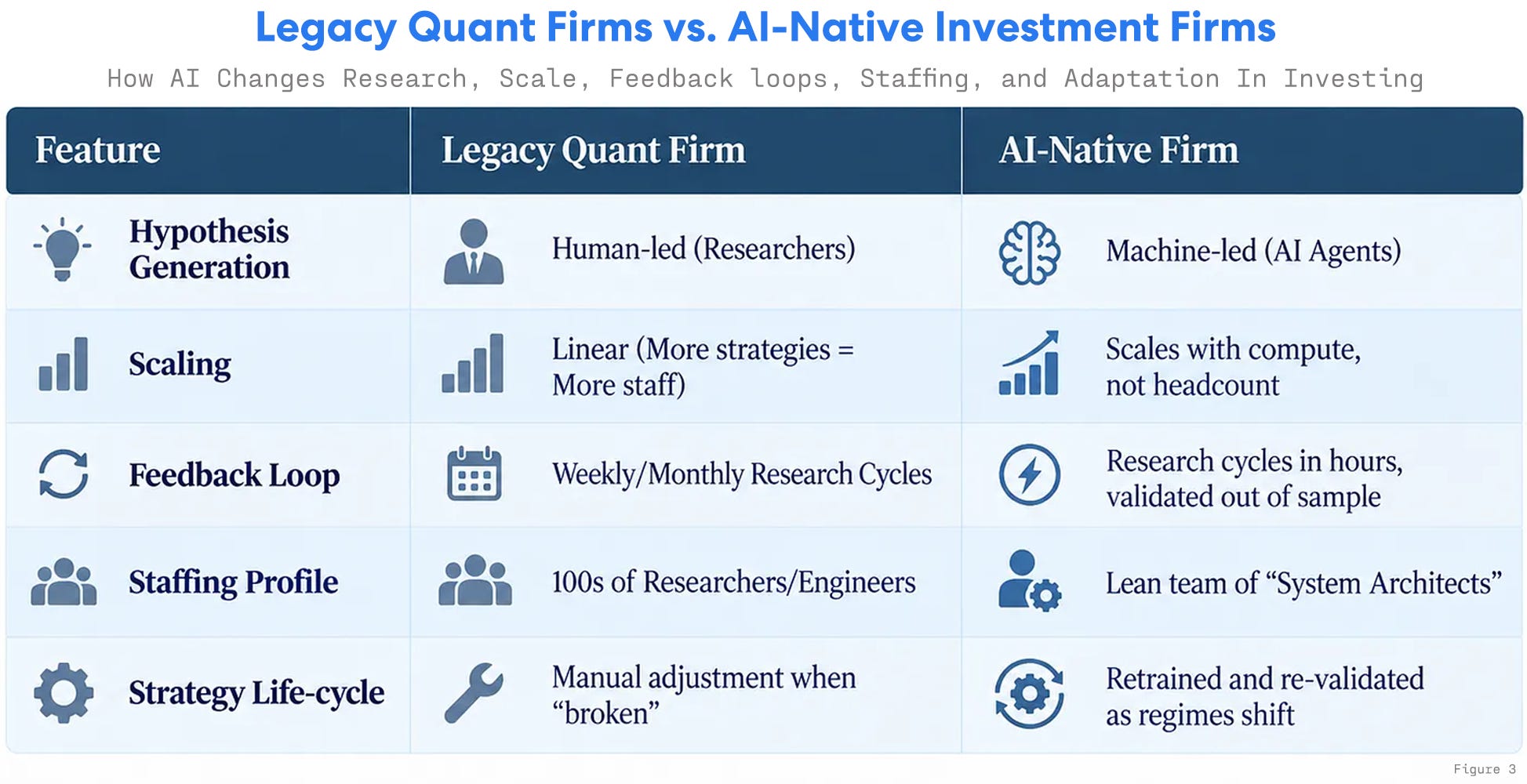
The first generation of quantitative firms used computers to execute investment models and strategies designed largely by humans. Developing a new strategy required teams of researchers to formulate hypotheses, clean datasets, build models, backtest strategies, evaluate results, and iterate.
Many incumbent firms will use AI to make this process faster and more productive. But adopting AI is not the same as becoming AI-native. Many large investment firms were built around separate strategies, teams, data systems, incentive structures, and research workflows. Their organizations were designed for a world in which human researchers generate ideas, while computers test and execute them. Rebuilding those firms around a shared learning architecture could require a much deeper organizational transformation than simply giving every researcher an AI copilot.
AI-native investment firms start from a different premise. They will increasingly use agents to participate in discovering and improving the strategies themselves. These agents could continuously search for new signals, generate hypotheses, construct portfolios, test strategies, identify deteriorating relationships, and adjust risk exposures as market conditions change.
A more radical version takes this one step further. Instead of humans defining individual strategies, a model could learn directly from market observations and take actions in the market, trained end-to-end against an objective based on realized risk-adjusted returns, transaction costs, liquidity, and market impact. Humans design the architecture, training environment, validation framework, and risk constraints that determine what gets deployed. In this scenario, the model is the strategy.
Either approach dramatically increases the pace of experimentation. An AI-native firm could run thousands of parallel experiments, each producing incremental improvements in models, portfolios, execution, and risk management. By automating more of the investment process itself, competitive advantage may shift from having the largest research organization to building the fastest learning organization.
We envision a relatively small group of professional investors, engineers, mathematicians, and AI researchers supervising an enormous digital research organization capable of operating 24 hours a day. Access to compute and raw data remain necessary, but insufficient as standalone advantages. The more durable moat may be the environment the model learns in, including proprietary market feedback, realistic transaction costs and liquidity constraints, robust reward functions, and the infrastructure that allows thousands of experiments to translate into better investment decisions.
The Coming Wave of AI-Native Funds
Over the next decade, we expect hundreds of AI-native investment firms and strategies to emerge. These firms will have a near-term advantage. But once the industry has access to similar foundation models and computing infrastructure, the competitive advantage will shift to what firms build on top of them and/or to the models they train themselves. The enduring firms will likely differentiate themselves across several dimensions, including:
Risk Architecture
Investment firms need to survive the inevitable periods when their models are wrong. AI can accelerate learning, decision-making and execution of investment ideas. Without proper risk controls, AI could also greatly amplify mistakes. The winners will build systems that know when to take risk and when to stop taking it, and ideally validate every model on data it has never seen before trusting it with capital.
Agent Architecture
The traditional quant model scaled research by adding researchers. AI-native firms will scale by deploying large networks of specialized agents. A small team of investors, engineers, and system architects could supervise thousands of agents generating hypotheses, testing strategies, challenging conclusions, and monitoring portfolios continuously. The competitive advantage will shift to the system that governs how these agents work together or, for firms that train a single end-to-end model, to the pipeline that turns market feedback into a better model.
Model Superiority
The best firms will build AI models that distinguish genuine market signals from near-term correlations and noise. They will find patterns that persist across changing markets and increased competition.
Proprietary Feedback Loops
The investment process needs to improve continuously and rapidly after every trade, prediction, portfolio decision, and market outcome. The firms that learn the fastest will identify what is working, abandon what is not and widen the gap over competitors.
Data Advantage
As with any other industry, proprietary data will become more valuable as general-purpose AI models are commoditized. Firms that create, acquire or uniquely structure information that competitors cannot easily replicate can build a durable data moat.
The VC Case for AI-Native Quants
AI will redefine capital markets and the new generation of investment firms will need to move from building better mathematical models to developing new systems for turning information into outsized returns. These AI-native funds will feature characteristics that VCs have historically looked for in technology companies: small initial teams, software-driven scalability, rapidly improving systems, research capacity that scales far faster than human headcount, and the potential to compound an information advantage over time. These firms could monetize investment models directly in the markets, license their models to third parties, or take a hybrid approach.
The biggest winners may not look like traditional hedge funds at all. They may look more like AI companies that happen to allocate capital. Their core asset will be a proprietary intelligence system, while capital will simply be a powerful way to monetize it.