


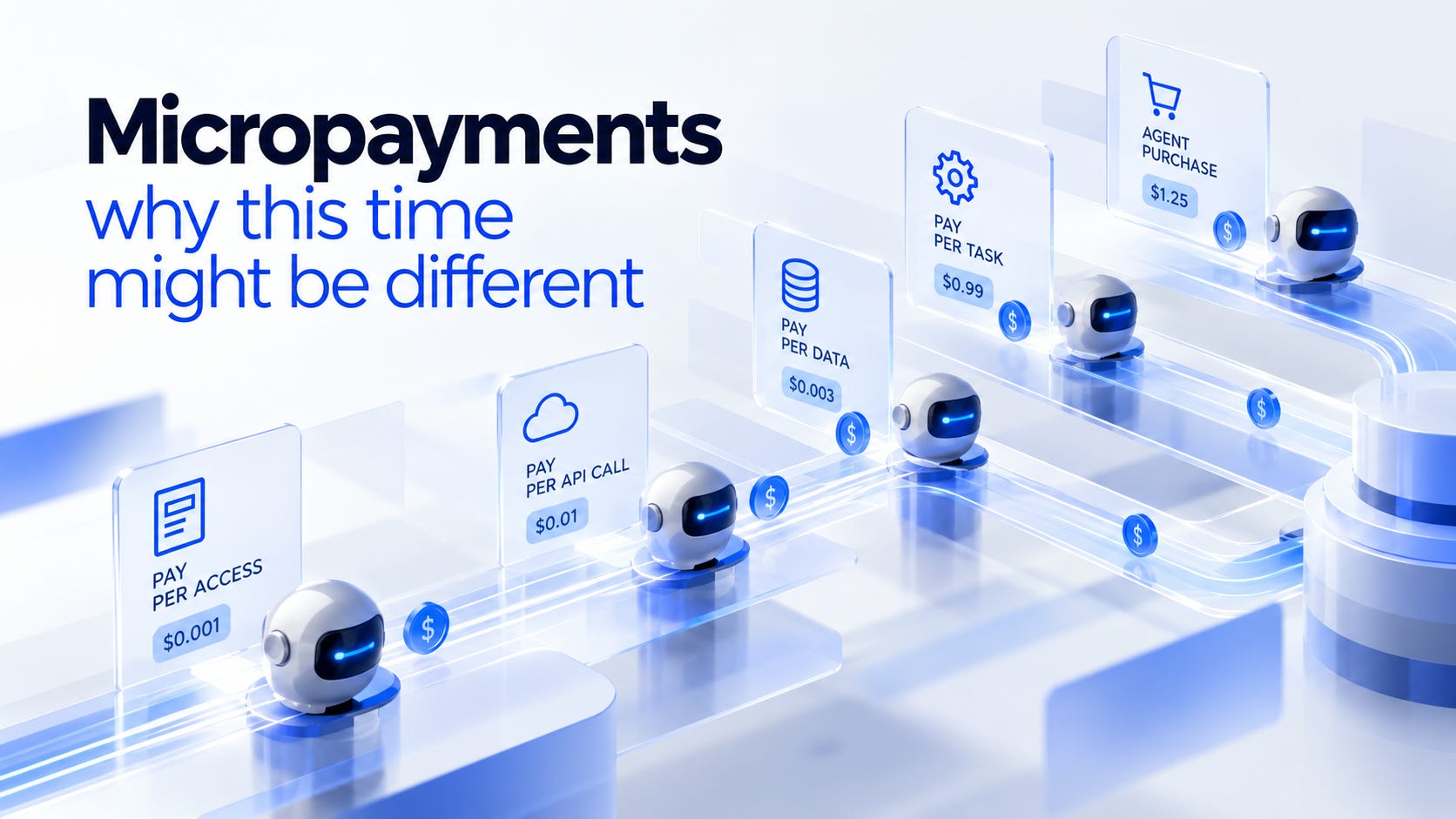
Micropayments died three times: the dot-com wallets, the carrier-billing boom, and the crypto tip-jar craze. Each time, smart people built sophisticated rails for a customer who didn’t exist.
The web’s architects saw it coming. In 1997, they reserved an HTTP error code, 402, “Payment Required,” for a future where pages would charge. Then they waited.
Here’s why nothing happened.
The math was brutal. Card fees have a variable piece (say, 2.5% of the sale) and a fixed piece ($0.03 to $0.25 or more). On a $1 purchase at 2.5% + $0.10, the merchant pays 2.5 cents plus 10 cents: 12.5 cents, a 12.5% fee. The fixed fee is what kills the micro-sale, and a three-cent sale can’t carry it.
The psychology was worse. Computer scientist Nick Szabo nailed it in 1999: the real cost isn’t processing; it’s thinking. Nobody wants to ask, “Is this worth 4¢?” thirty times a day.
Nobody wanted to pay anyway. Only 17% of people in 20 countries pay for online news, and that number hasn’t budged in 2026, per the Reuters Institute.
The problem was never the pipe. It was the consumer.
Enter the Agents
Remove the human consumer, and the problem changes shape. Three things happened at once.
Software became a buyer. An agent can weigh thousands of tiny purchases against a rule like “spend up to $5 on this report” and never get tired. Forrester’s take on Stripe’s new Machine Payments Protocol (MPP) was blunt: there’s no human decision between request and payment.
The pipes got cheap. Circle’s Nanopayments bundle payment approvals and settle them in bulk, which makes prices as low as $0.000001 per call workable. Visa and Artemis found the average payment on x402, Coinbase’s open protocol, is under a cent.
Pricing started following the work. Seat-based pricing dropped from 21% to 15% of SaaS companies in a year, while hybrid models jumped from 27% to 41%, per one Pilot study. Intercom’s Fin AI agent charges $0.99 per resolved customer conversation. When software does the job, you pay for the job.
The Establishment Shows Up
Here’s the tell. In July 2026, the Linux Foundation launched the x402 Foundation with 40 members: Visa, Mastercard, Stripe, Google, AWS, Cloudflare, and more. Rivals don’t write standards together unless they smell a market.
What’s the Financial Upside?
Now the cold water. Visa and Artemis counted about $15 million in adjusted x402 volume across 109.6 million transactions through April 2026. Artemis found roughly half of early activity was self-dealing or wash trading, essentially bots paying themselves. Stripe’s MPP did about $25,000 in its first 33 days.
Translation: the infrastructure arrived before the economy. That’s normal. Whoever finds real, repeat demand wins.
Where the Cash Is Actually Landing
So where should investors and founders focus? Four markets are showing real signs of life.
Crawler tolls. AI bots scrape far more than they send back. TollBit measured early-2025 scrape-to-referral ratios of 179:1 for OpenAI, 369:1 for Perplexity, and a jaw-dropping 8,692:1 for Anthropic. So Cloudflare now blocks AI crawlers by default and lets publishers charge per visit, from $0.001. About 20% of TollBit’s nearly 7,000 publisher sites have earned revenue. Small, but real.
Metered tools and data. Firecrawl charges a penny per web scrape over x402. Lightning Labs’ L402 charges satoshis per call. AWS shipped AgentCore Payments in May.
Licensing by the use. RSL 1.0 lets publishers post machine-readable pay-per-crawl and pay-per-inference terms. Perplexity’s Comet Plus shares 80% of subscription revenue with publishers.
Agents on card rails. Mastercard Agent Pay is live in the US and five Asia-Pacific markets. Visa has completed hundreds of agent-initiated transactions. McKinsey sees up to $1 trillion in US retail revenue flowing through agents by 2030, mostly on cards.
That last point matters. This isn’t cards versus crypto. It’s a hybrid: cards for bigger purchases you might want to reverse, and stablecoins for machine-to-machine trades. McKinsey puts end-user stablecoin payments at about $390 billion in 2025, as the US GENIUS Act and the EU’s MiCA give them legal footing.
Follow the Control Points
Here’s what thirty years have taught us: the rails always get commoditized. The money lives somewhere else.
In this market, that’s identity, rules, routing, and recourse. Who is this agent? What may it spend? Who gets paid, and what happens when something goes wrong? Investors are already circling. Skyfire, Basis Theory, Inflow, and Nekuda have raised nearly $50 million combined.
The sharpest edge belongs to companies that see both the data (what was asked, by whom) and the money (who paid, under which rules). Data flows and money flows become a single event. That’s the moat.
What Is at Risk
Three things could still wreck this.
Hijacked bots. In May 2026, an attacker used Morse code to get Grok to tell a trading bot to move roughly $150,000 to $200,000 in tokens. The fix: enforce spending limits at the wallet, outside the AI model.
Who pays when it goes wrong? Chargeback systems assume a human bought one thing, not that a bot made 10,000 chained calls.
Gatekeepers. Open protocols don’t guarantee open distribution.
What to Do Now
Publishers: price machine access before someone else does.
Software founders: pilot usage-based pricing on one product line.
Payments teams: build for rules, not checkout screens.
Investors: back the control layer and demand proof of repeat, non-wash volume.
The Takeaway
Micropayments won’t replace cards, subscriptions, or ads. They’ll become the quiet settlement layer for everything machines buy from each other. The code that waited nearly 30 years for a customer finally has one: the agent.